
As AI infrastructure continues to scale, the optical interconnect industry is moving toward higher bandwidth, greater power efficiency, and more flexible deployment architectures. While 1.6T is entering large-scale pilot deployment, 3.2T (equivalent to 16×224G or 32×100G) is emerging as the next major step in high-speed data center connectivity.
For 3.2T optical interconnects, however, simply increasing bandwidth also brings new challenges in power consumption, signal integrity, thermal management, and system interoperability.
FIBERSTAMP’s HYBRID architecture extends the “Semi-DSP + half-linear” approach, already validated at 800G, toward a pluggable 3.2T form factor. The approach provides an evolutionary path that reduces reliance on new full-DSP capacity, avoids the need for liquid-cooling upgrades, and maintains serviceability.
I. Three Major Challenges in the 3.2T Era
Full-DSP 3.2T
Power consumption can reach the 40–50W range, creating significant thermal challenges for air-cooled front-panel deployments.
Pure-Linear LPO/NPO 3.2T
At 224G/lane, the architecture is highly sensitive to Host SerDes and PCB losses. Interoperability risks also increase for 500m single-mode transmission and multi-vendor deployments.
LRO Single-Direction DSP
LRO devices remain niche products with long lead times, while the supporting ecosystem is still maturing.
These challenges highlight the need for an architecture that can balance performance, power consumption, system complexity, and deployment flexibility.
The HYBRID Architecture
HYBRID = (LRO + LTO) / 2
The HYBRID architecture combines two approaches within the same optical module. Across the 8/16 channels, half use mature duplex DSPs, while the other half use direct linear drive.
System-level clock and phase sharing provides reference information to the linear channels, allowing the architecture to reduce the amount of DSP processing required while maintaining system-level coordination.
II. Key Technical Elements of the HYBRID 3.2T Solution
- Channel architecture: Of the 16 channels operating at 224G/lane, 8 retain full-DSP retiming, while the other 8 use direct drive with a linear Driver + TIA.
- DSP reuse: The architecture reuses the mass-produced 1.6T duplex DSP.
- Optical engine: Silicon photonics DR8×2, supporting ELS external light sources. The architecture builds on silicon photonics technology for external light sources across 800G, 1.6T, and 3.2T applications.
- Form factor: OSFP-XD / OSFP224 pluggable modules designed to support existing switch front panels and air-cooling architectures.
- System-level coordination: Through CMIS and proprietary DSP-TAP registers, the reference clock, phase, and FEC margin of the DSP channels are exposed to the host for tuning. This allows the linear channels to leverage clock-lock information from the DSP channels rather than performing phase acquisition from scratch.
III.Key Benefits Compared With Conventional Full-DSP 3.2T
| Dimension | Full-DSP 3.2T | Pure-Linear 3.2T NPO | HYBRID Semi-DSP 3.2T |
| Typical Power Consumption | 40–50W | 18–22W (ASIC-dependent) | 28–34W (20–30% lower) |
| Latency | High (hundreds of nanoseconds) | <1 ns | Approximately 50% lower (similar to LRO) |
| 500m Single-Mode Reach | Strong | Limited / unstable | Achievable (PRE-FEC BER of E-9 to E-10) |
| DSP Architecture | Custom full-duplex DSP, fully enabled | None | Mature duplex DSP used on only half of the channels |
| BOM Cost | Baseline: 100% | Lowest | Approximately 20% lower |
| Host SerDes Requirements | Low | Extremely high | Moderate (DSP channels provide fallback) |
| Thermal Management | Poor (liquid cooling required) | Good, but difficult to tune | Cold-plate liquid cooling |
| Evolution Toward CPO | Requires redesign | Can migrate directly to CPO | The same “half-system coordination” concept can be extended to CPO |
IV.Four Major Commercial Benefits for AI Cluster
1. Support for Pluggable 3.2T Architectures with Air Cooling:
3.2T can support enhanced, low-density OSFP air-cooled chassis.
2. Reduced Dependence on DSP Production Capacity
The architecture reduces the need for new 3.2T DSP capacity by leveraging existing DSP technology, allowing half of the DSP resources to support twice the bandwidth.
3. Open Tuning and Greater Customer Control
The host system can adjust equalization, gain, and FEC strategies, helping shorten the joint-debugging cycle for customer-developed switches.
4. A Smooth Path Toward NPO/CPO
The same “half-system coordination” concept can be extended to NPO optical engines.
V. HYBRID Product Roadmap
The HYBRID architecture can be extended across multiple generations of optical interconnects:
- 800G OSFP HYBRID DR8 / 2×DR4: Mature, with prototypes already available.
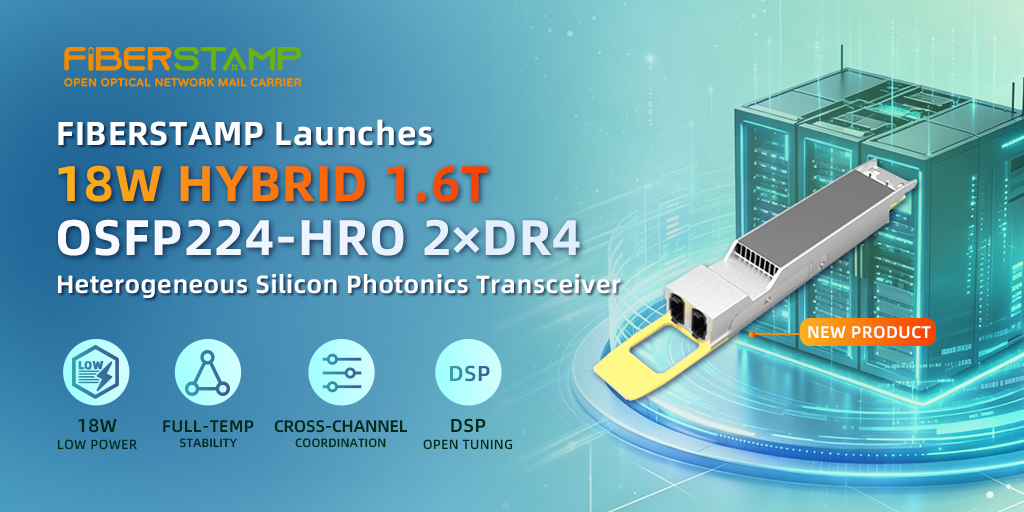
- 1.6T OSFP-HRO 2×DR4 HYBRID: Prototypes already available.
- 3.2T OSFP-XD/OSFP HYBRID silicon photonics pluggable modules: Included in the roadmap.
- 3.2T pluggable optical modules with external light sources, as well as enhanced 3.2T NPO silicon photonics engines: Included in the roadmap.
VI. Looking Ahead
As AI infrastructure continues to evolve toward higher-speed and more demanding interconnects, the industry will need optical solutions that balance bandwidth, power efficiency, thermal performance, and deployment flexibility.
FIBERSTAMP will continue to advance its HYBRID architecture and explore its potential across next-generation 3.2T pluggable optical modules and NPO silicon photonics engines, with support for 500m transmission. By extending the Semi-DSP approach to higher-speed interconnects, FIBERSTAMP aims to contribute to the continued evolution of efficient and scalable optical connectivity for AI data centers.