Wavelength Division Multiplexing (WDM) has become a cornerstone of modern optical communications, enabling multiple wavelengths to be transmitted simultaneously over a single optical fiber.By significantly increasing fiber capacity without deploying additional infrastructure, WDM plays a vital role in metro, long-haul, and data center interconnect (DCI) networks.
At the heart of every WDM subsystem is an optical filtering architecture that combines and separates wavelength channels with high precision. Among the most widely used solutions are Z-Block and Thin Film Filter (TFF) Prism technologies. Although both perform the same fundamental function, they differ in optical design, manufacturing processes, and application characteristics.
This article provides an overview of how these two technologies work and the key factors to consider when selecting a WDM optical solution.
What Is Z-Block Technology?
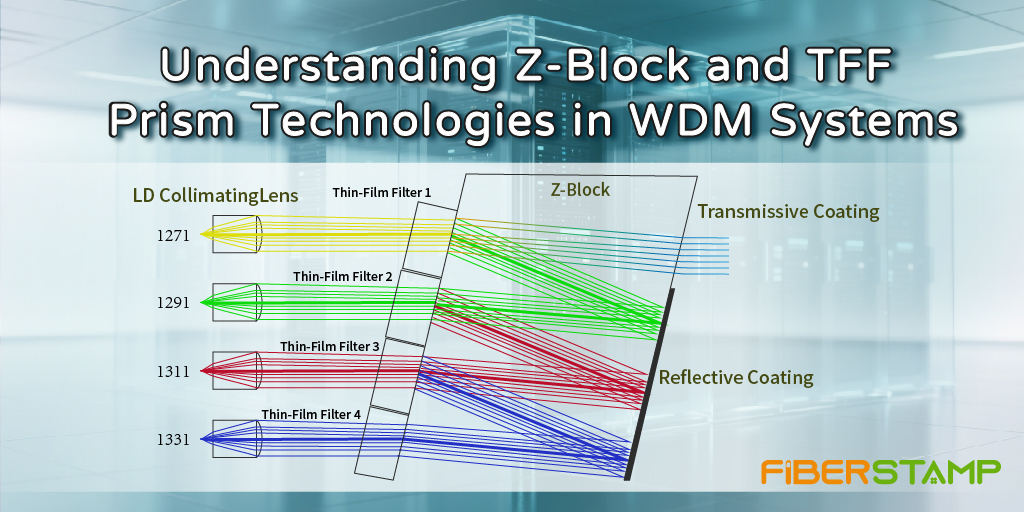
Block is a highly integrated free-space optical assembly designed for wavelength multiplexing and demultiplexing. It integrates multiple precision optical components—including thin-film filters, mirrors, collimating lenses, and fiber arrays—within a single compact optical module.
The name “Z-Block” comes from the zigzag optical path that light follows as it passes through multiple reflective and transmissive optical elements inside the assembly.
By integrating these components into one precisely aligned structure, Z-Block technology delivers consistent optical performance while reducing the number of discrete optical assemblies required.
How Does Z-Block Work?
During demultiplexing, the incoming optical signal enters the Z-Block through a collimating lens, which converts the divergent beam into parallel light before it reaches a sequence of thin-film filters.
Each filter extracts one wavelength channel while allowing the remaining channels to continue through the optical path. Mirrors redirect the separated wavelengths toward their designated output ports until all channels have been demultiplexed.
When operating as a multiplexer, the process is simply reversed, combining multiple wavelength channels into a single output fiber.
This integrated optical path helps maintain low insertion loss and stable wavelength performance across multiple channels.
Advantages and Limitations of Z-Block
Key advantages include:
- Highly integrated architecture
- Low insertion loss
- Excellent wavelength consistency
- Compact package design
- High mechanical stability
Limitations
- Complex optical alignment during manufacturing
- Higher production cost compared with simpler assemblies
- Limited flexibility after final assembly
- Tight manufacturing tolerances
What Is TFF Prism Technology?
Thin Film Filter (TFF) Prism technology is another well-established optical filtering architecture widely used in CWDM and DWDM systems. Rather than integrating all optical elements into a single assembly, it combines precision thin-film filters with prism optics to separate or combine optical wavelengths.
Each thin-film filter is coated with multiple dielectric layers designed to selectively reflect or transmit specific wavelengths while the prism guides the optical path between filtering stages.
TFF Prism technology has been widely deployed in CWDM and DWDM applications due to its mature manufacturing process and proven reliability.
How Does TFF Prism Work?
As the optical signal enters the prism assembly, it is directed toward a series of thin-film filters.
Each filter is designed for a specific wavelength channel. Depending on its optical coating, a particular wavelength is either reflected toward an output port or transmitted to the next filtering stage.
This sequential filtering process continues until every wavelength has been separated or combined.
Because each optical element performs an individual filtering function, TFF Prism assemblies offer excellent wavelength selectivity while supporting flexible channel configurations.
Advantages and Limitations of TFF Prism
Key advantages include:
- Mature and proven technology
- High wavelength selectivity
- Excellent channel isolation
- Flexible optical configurations
- Reliable long-term performance
Limitations
- Larger optical assembly compared with integrated designs
- More individual optical components
- Cumulative insertion loss may increase as channel count grows
- Assembly complexity increases with higher channel densities
Z-Block vs. TFF Prism
Although both technologies are designed for wavelength multiplexing and demultiplexing, each offers distinct advantages depending on the application.
| Feature | Z-Block | TFF Prism |
| Optical Design | Integrated optical block | Prism with thin-film filters |
| Integration Level | High | Moderate |
| Channel Density | High | Moderate to High |
| Manufacturing | Precision integrated assembly | Sequential optical assembly |
| Best Suited For | High-density DWDM | CWDM & DWDM |
| Flexibility | Moderate | High |
Neither technology is universally better than the other. The optimal choice depends on system requirements such as channel count, insertion loss, package size, manufacturing complexity, and overall network design.
Conclusion
Z-Block and TFF Prism technologies both play important roles in modern WDM systems. While they share the same objective of efficiently multiplexing and demultiplexing optical wavelengths, they achieve this through different optical architectures and manufacturing approaches.
Understanding the characteristics of each technology allows network designers and system integrators to select the most appropriate solution based on performance requirements, scalability, and application needs.
As WDM technologies continue to advance, both Z-Block and TFF Prism architectures will remain essential optical building blocks, supporting higher-capacity networks with reliable wavelength multiplexing and demultiplexing performance.
FIBERSTAMP Insight
From CWDM and DWDM to O-Band TFF MUX/DEMUX and coherent optical solutions, FIBERSTAMP focuses on delivering precision-engineered WDM subsystems designed for stable optical performance and long-term reliability.