As AI workloads scale and data center architectures evolve, optical interconnect technology is undergoing a fundamental transformation. Traditional pluggable optics are being challenged by two emerging approaches—Linear-drive Pluggable Optics (LPO) and Co-packaged Optics (CPO)—both driven by the industry’s urgent need for lower power consumption, higher bandwidth density, and improved system efficiency.
At the heart of this transition are three core components: optical transceivers, optical DSPs (oDSPs), and switch ASICs. How these elements are partitioned, optimized, and integrated defines the technical and economic trade-offs between LPO and CPO.
I. Core Components of Optical Interconnect Systems
1. Optical Transceivers: The Electro-Optical Bridge

Optical transceivers enable bidirectional conversion between electrical and optical signals and are indispensable in modern data centers and telecom networks.
Key functions include:
Electro-Optical Conversion
Laser sources modulate electrical signals into light at the transmitter, while photodetectors convert optical signals back to electrical form at the receiver.
Rate and Reach Adaptation
Supporting industry-standard form factors such as QSFP-DD and OSFP, transceivers scale from 100G to 1.6T and address distances from short-reach (50 m) to 2 km interconnects.
Signal Conditioning
Conventional pluggable optics rely heavily on onboard DSPs for equalization, forward error correction (FEC), and dispersion compensation—often accounting for nearly half of the module’s total power consumption at 400G and above.
2. Optical DSPs (oDSPs): The Intelligence Engine
Optical DSPs represent the most complex and highest-value electrical components inside transceivers, typically contributing 20–30% of the BOM cost.
Their core roles include:
Advanced Modulation and Demodulation
In data center environments, PAM4 DSPs enable higher per-lane data rates (50G/100G) while compensating for signal distortion. In long-haul networks, coherent DSPs employ advanced modulation formats to maximize reach and sensitivity.
Signal Regeneration and Error Correction
Digital processing such as FEC restores degraded signals and ensures transmission reliability over extended distances.
Power Consumption Constraints
At 800G, oDSPs alone can consume 6–8 W, making them the dominant contributor to module power dissipation and a key bottleneck for further scaling.
3. Switch ASICs: The Data Center Traffic Hub
Switch ASICs form the backbone of data center networking, responsible for ultra-high-speed packet forwarding and port connectivity.
Key capabilities include:
High-Speed SerDes Connectivity
Supporting 112G and future 224G SerDes, ASICs enable massive port density and low-latency interconnects between servers, accelerators, and storage.
Integrated Signal Processing
Modern ASICs increasingly incorporate PAM4 interfaces, clock recovery, and basic equalization to preserve signal integrity.
Expanded Role in LPO Architectures
In LPO systems, switch ASICs take on part of the signal conditioning traditionally handled by DSPs, enabling simplified, lower-power optical modules.
II. LPO and CPO: Technology Paths and Industry Impact
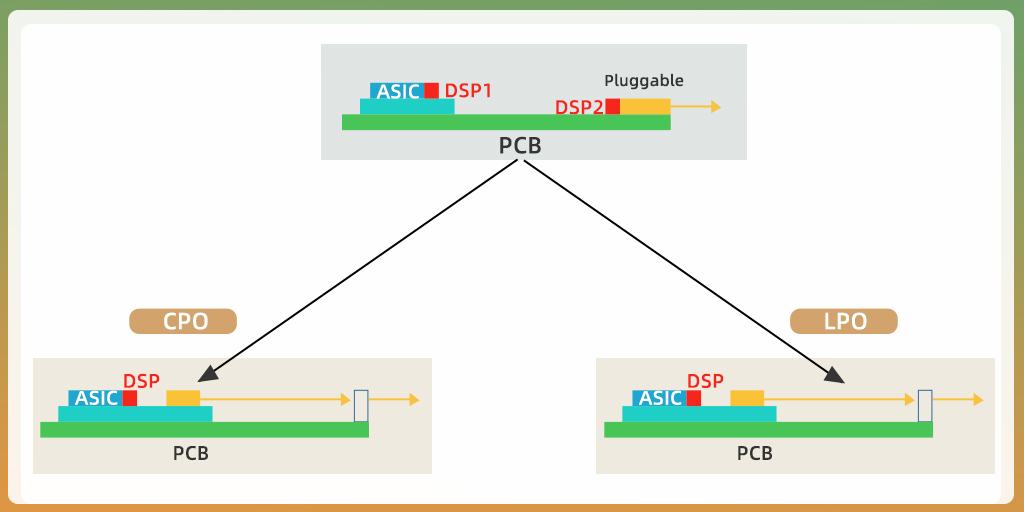
1. LPO: Driving Efficiency Within the Pluggable Ecosystem
Linear-drive Pluggable Optics (LPO) represent an evolutionary step that optimizes today’s pluggable form factors for power and cost efficiency.
Key Technical Characteristics
DSP-Free Architecture
LPO replaces traditional DSPs with high-linearity Driver and TIA components, eliminating CDR and complex digital processing. This significantly reduces power consumption, latency, and system cost, particularly in 800G applications.
Operational Compatibility
Retaining QSFP-DD and OSFP formats, LPO preserves hot-swappability and operational flexibility—critical for large-scale deployment and maintenance.
Standards Alignment
LPO is built around OIF CEI-112G-Linear-PAM4 specifications. While 800G adoption is underway, future 224G SerDes validation remains a key milestone.
Industry Impact
Power and Cooling Savings
In dense AI racks, LPO can deliver substantial energy savings, reducing both electrical and cooling costs at the system level.
Supply Chain Diversification
By minimizing DSP dependency, LPO accelerates innovation in Driver/TIA silicon and broadens supplier participation.
Application Boundaries
Because signal compensation shifts upstream to the switch ASIC, LPO is best suited for short-reach, homogeneous environments, such as AI training clusters.
2. CPO: Unlocking the Next Level of Bandwidth Density
Co-packaged Optics (CPO) represent a more disruptive architectural shift—bringing optical engines physically closer to, or directly integrated with, the switch ASIC.
Technical Evolution
From Near-Package to Co-Package
Transitioning from co-board optics to true CPO shortens electrical traces from centimeters to millimeters, delivering 30–50% power reduction and improved signal integrity.
Advanced Packaging Architectures
CPO implementations range from 2.5D integration to chiplet-based and future 3D stacking approaches, enabling deeper convergence of silicon photonics and switching silicon.
Silicon Photonics at the Core
High-density, scalable silicon photonics is foundational to CPO, with industry projections indicating it will dominate optical integration in the coming decade.
Industry Impact
Extreme Performance Scaling
CPO architectures enable system bandwidths beyond 51.2T with ultra-low latency, directly addressing the demands of next-generation AI and accelerated computing fabrics.
Ecosystem and O&M Challenges
Early CPO deployments rely on proprietary designs and face higher operational complexity, including limited field replaceability.
Clear Market Segmentation
CPO primarily targets scale-up AI networks, while scale-out data center architectures continue to rely on pluggable optics.
III. Technology Outlook: Competition, Coexistence, and Convergence
1. Multi-Path Evolution
LPO as a Mid-Term Mainstream Solution
Between 2025 and 2027, LPO is expected to see rapid adoption in AI clusters and mid-scale data centers, driven by its balance of efficiency and deployability.
CPO as a Long-Term Strategic Direction
Beyond 2030, CPO is likely to gain traction in hyperscale environments as packaging, silicon photonics, and open ecosystems mature.
DSP Remains Essential
DSP-based optics will continue to dominate long-reach and heterogeneous network scenarios, evolving toward more power-optimized designs.
2. Synergistic Innovation
Silicon Photonics as a Common Enabler
Advances in silicon photonics benefit both LPO—through lower-cost, high-performance optics—and CPO—through dense, integrated optical engines.
Packaging Breakthroughs
3D integration, TSVs, and advanced thermal solutions will be critical to unlocking CPO’s full potential.
Standards and Ecosystem Development
LPO benefits from ongoing IEEE and OIF standardization, while CPO’s future depends on broader industry collaboration and open interfaces.
3. Supply Chain Transformation
Chip Vendors
Traditional DSP leaders continue to innovate, while system players integrate optics more tightly with switching silicon to enhance platform differentiation.
Optical Module Providers
Vendors such as FIBERSTAMP are actively investing in LPO and future CPO-ready technologies, balancing near-term deployment with long-term architectural shifts.
Manufacturing and Foundries
Expanded silicon photonics capacity and advanced packaging capabilities are becoming strategic enablers for next-generation optical interconnects.
IV. Conclusion
The rise of LPO and CPO marks a decisive transition from DSP-centric pluggable optics toward more power-efficient, tightly integrated interconnect architectures. LPO offers a practical, near-term path to reduced power and cost, while CPO represents the long-term vision for ultra-high-bandwidth, AI-driven data centers.
Rather than a zero-sum competition, LPO and CPO will coexist and evolve synergistically, each serving distinct application layers within the data center. For the industry, success will depend on advances in silicon photonics, packaging, and—most critically—open standards and ecosystem collaboration.
At FIBERSTAMP, we believe this multi-path evolution will define the next decade of optical networking—driving smarter, more efficient, and more scalable connectivity for AI and cloud infrastructure.