
1. Architecture Overview of Modern Computing Networks
With the rapid scaling of AI training and inference clusters, data center interconnect architectures are evolving into a clearly defined layered model.
Modern computing networks are generally divided into two distinct layers:
Scale-Across Network (Short-to-Medium Reach Interconnects)
This layer connects computing nodes across racks, cabinets, and within data halls, typically spanning distances from hundreds of meters to a few kilometers. It is highly latency-sensitive and cost-sensitive, forming the foundation of GPU/NPU cluster interconnects.
Computing Backbone Network (Long-Haul Interconnects)
This layer enables inter-data center and inter-city resource coordination over distances ranging from tens to thousands of kilometers. It requires high spectral efficiency and long-distance transmission capability, where coherent optical technology is essential.
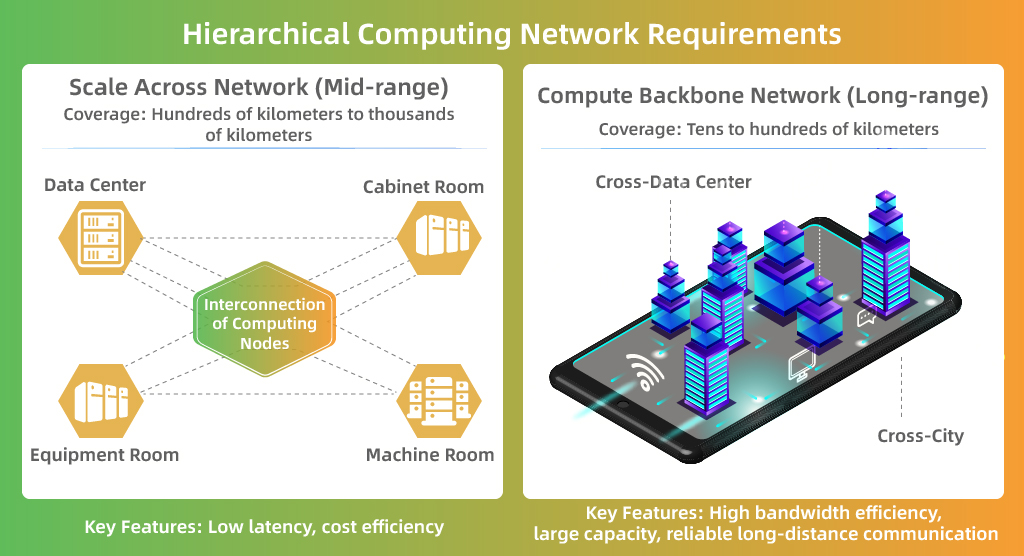
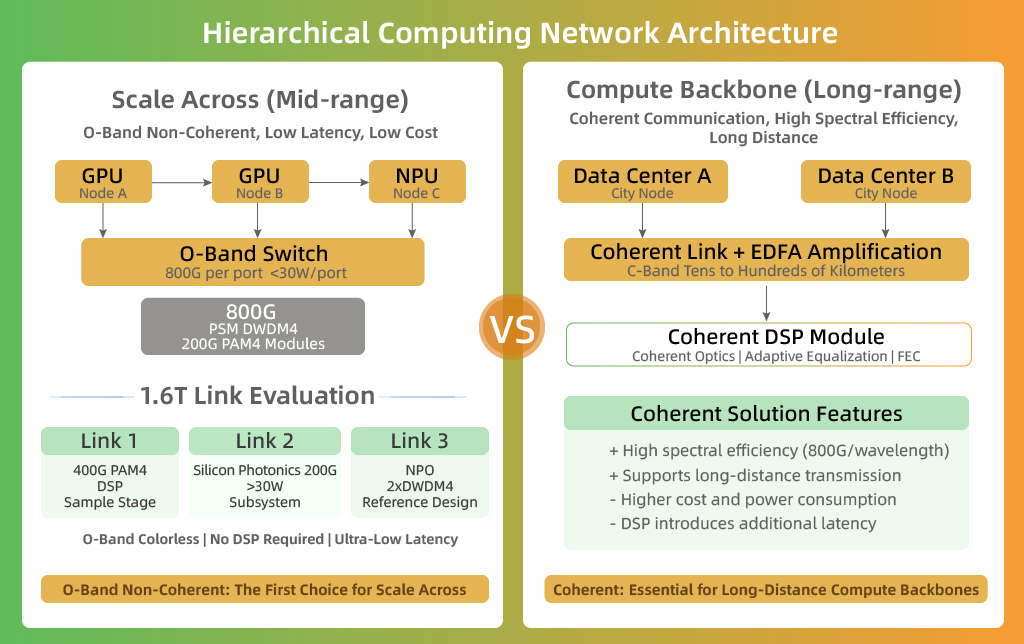
These two network layers impose fundamentally different requirements on optical interconnect technologies. While coherent optics is indispensable for long-haul transmission, Scale-Across networks do not require coherent architectures. In these scenarios, the added complexity, power consumption, and latency of coherent systems become unnecessary overhead.
2. Why O-Band Incoherent for Scale-Across Networks
The O-Band spectrum (1260–1360 nm) provides an optimal operating window for short-to-medium reach optical interconnects in data center environments.
Zero-Dispersion Operation Window
O-Band operates near the zero-dispersion region of standard single-mode fiber, eliminating the need for dispersion compensation. This enables robust signal integrity and supports high-speed PAM4 modulation without DSP-based dispersion equalization.
Ultra-Low Latency Architecture
By removing coherent DSP processing, O-Band incoherent systems significantly reduce end-to-end latency. This is particularly critical for AI workloads such as All-Reduce operations and distributed training synchronization.
Lowest Total System Cost
O-Band incoherent architectures eliminate the need for local oscillator lasers, 90-degree optical hybrids, and complex DSP engines. This significantly reduces system BOM cost while enabling silicon photonics-based implementation.
In Scale-Across applications, O-Band incoherent solutions deliver the optimal balance of cost, power efficiency, and latency.
3. Current Product Capability: Scalable to 800G
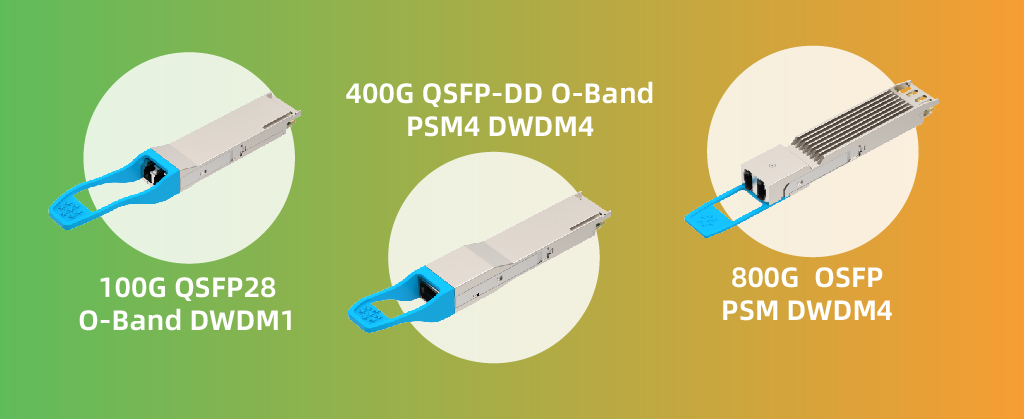
The current single-wavelength 100G O-Band incoherent architecture supports seamless scaling up to 800G interconnect bandwidth.
Future 800G implementations can be built on mature single-channel 200G PAM4 technology, offering a low-risk and highly manufacturable solution path with proven system stability.
4. 1.6T Scale-Across Evolution Pathways
As interconnect bandwidth evolves toward 1.6T-class systems, three viable architectural approaches are identified, each with different maturity levels and design trade-offs.
Path 1: 1.6T PSM DWDM (Single-Wavelength 400G PAM4, Silicon Photonics)
This represents a high-performance single-module architecture based on advanced silicon photonics modulation.
While 400G single-wavelength PAM4 DSP technology has not yet reached mass production, 1.6T-class DR4 samples have already emerged in the industry, indicating early feasibility of 400G PAM4 DSP development.
This path is considered a mid-term evolution direction as the ecosystem matures.
Path 2: 1.6T Dual-Module Aggregation (Single-Wavelength 200G PAM4)
This architecture is based on mature 200G PAM4 silicon photonics technology, achieving 1.6T bandwidth through aggregation of two 800G-class optical engines.
While technically feasible, total system power consumption becomes the primary constraint. If power exceeds 30W, direct switch-port powering is no longer viable, requiring additional power delivery mechanisms and compromising pluggable module simplicity.
As a result, this approach is suitable for specific subsystem deployments but is unlikely to become the mainstream Scale-Across architecture.
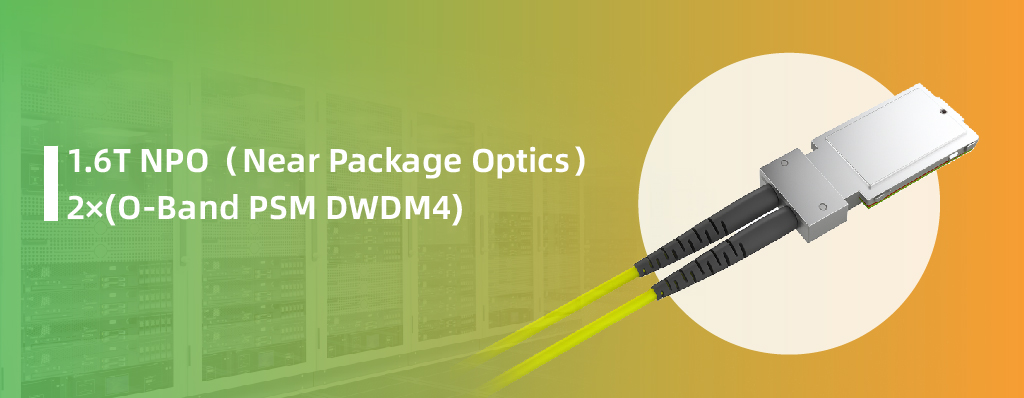
Path 3: 1.6T NPO Architecture (Recommended)
The Near-Package Optics (NPO) architecture integrates the optical engine close to or within the switch ASIC package, fundamentally addressing both power delivery and signal integrity limitations.
This represents the most practical and scalable path for 1.6T Scale-Across systems at the current stage.
Key advantages include:
- Ultra-short electrical trace lengths, significantly reducing SerDes power consumption
- Removal of pluggable module power constraints
- Based on proven 2×PSM DWDM architecture with a clear evolution roadmap
- Enables full realization of 1.6T O-Band incoherent Scale-Across systems
5.Comparative Summary of Technology Pathways
| Solution | PAM4 Modulation | Speed | DSP Maturity | Power | Switch Direct Support | Recommended Scenario |
| 800G OSFP PSM DWDM4 | Single-Wave 200G | 800G | Mature | ≤18W | Yes | Mainstream Scale Across |
| 1.6TPSM DWDM4 (400G PAM4) | Single-Wave 400G | 1.6T | Sample Stage | TBD | To be verified | Mid-term evolution direction |
| 1.6T 2×PSM DWDM4 | Single-Wave 200G | 1.6T | Mature | >30W | No | Specific subsystem deployment |
| 1.6T NPO 2×PSM DWDM4 | Single-Wave 200G | 1.6T | Mature | Controllable | Yes (NPO Architecture) | Recommended main route |
6.Conclusion
Scale-Across computing networks are defined by four fundamental requirements: low latency, low cost, high port density, and operational simplicity.
In short-to-medium reach interconnect scenarios, the complexity introduced by coherent optical systems is unnecessary and inefficient. O-Band incoherent architectures naturally align with these system-level requirements.
FIBERSTAMP O-Band incoherent solutions provide a production-ready and scalable platform:
- 400G and 800G PSM DWDM architectures are already mature for large-scale deployment
- 1.6T-class systems can be achieved through continued architectural innovation
FIBERSTAMP delivers next-generation O-Band incoherent optical interconnect solutions designed for AI-scale computing infrastructure, enabling high-density, low-latency, and cost-optimized Scale-Across networks.