
FIBERSTAMP’s Hybrid Architecture Active Optical Cable (AOC) portfolio delivers a new generation of high-speed, energy-efficient optical interconnects for AI, hyperscale data center, and cloud infrastructures. Based on a patented Hybrid interconnect architecture, these AOC solutions combine advanced system-level signal alignment with flexible implementation options — including VCSEL-based and silicon photonics-based designs — for superior performance over traditional DSP-centric approaches.
Unlike conventional full-DSP optical links, the Hybrid architecture applies DSP to only half of the channels, significantly cutting power consumption and latency while maintaining robust signal integrity. Built on industry-proven LPO/LRO design principles and enhanced through precise system alignment, the Hybrid methodology is captured by the concept:
HYBRID = (LTO + LRO) / 2 — delivering a strategic balance between linear-drive efficiency and targeted DSP support.
Key Highlights
- Superior Efficiency: Enhanced signal alignment and reduced DSP overhead translate into lower operational cost and improved link performance
- Multi-Rate Coverage: Comprehensive support across 400G, 800G, and 1.6T OSFP224 form factors
- Reduced Power: Hybrid AOCs offer significantly lower power consumption compared with traditional DSP solutions — enabling greener and more scalable network designs
- Extended Reach: Transmission distances include up to 30 m on OM3, 50 m on OM4 multimode fiber, and up to 500 m on single-mode fiber (SMF)
FIBERSTAMP Hybrid AOC Portfolio
| Product | Power Consumption |
| 400G QSFP-DD Hybrid VR8-AOC | 6.6 W |
| 800G OSFP Hybrid VR8-AOC | 9 W |
| 800G OSFP Hybrid PSM8-AOC-SiPh | 12.5 W |
| 1.6T OSFP224 Hybrid PSM8-AOC-SiPh | 20 W |
Application Scenarios
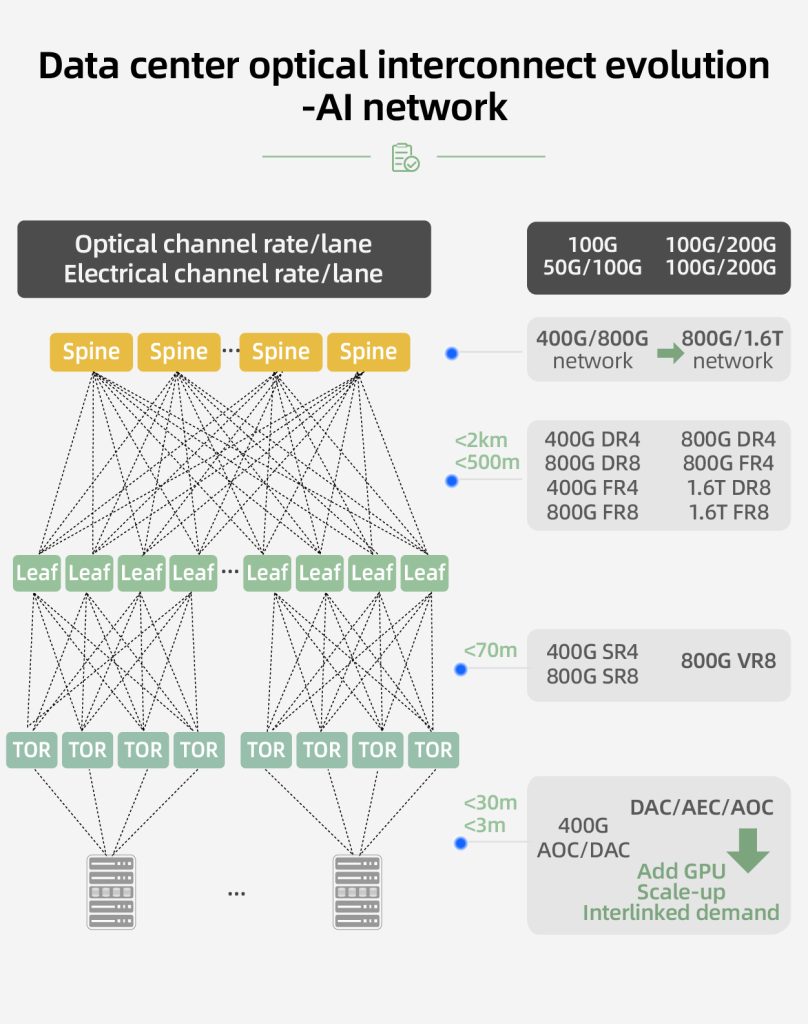
FIBERSTAMP’s Hybrid AOC solutions are ideal for:
- High-density AI/ML cluster interconnects
- Hyperscale and cloud data center spine and leaf fabrics
- Network architectures requiring low latency, high throughput, and energy efficiency
By redefining active optical cabling with Hybrid architecture, these solutions deliver higher performance, lower power, and improved cost efficiency compared to conventional optical links — empowering the next wave of AI-driven infrastructure growth.